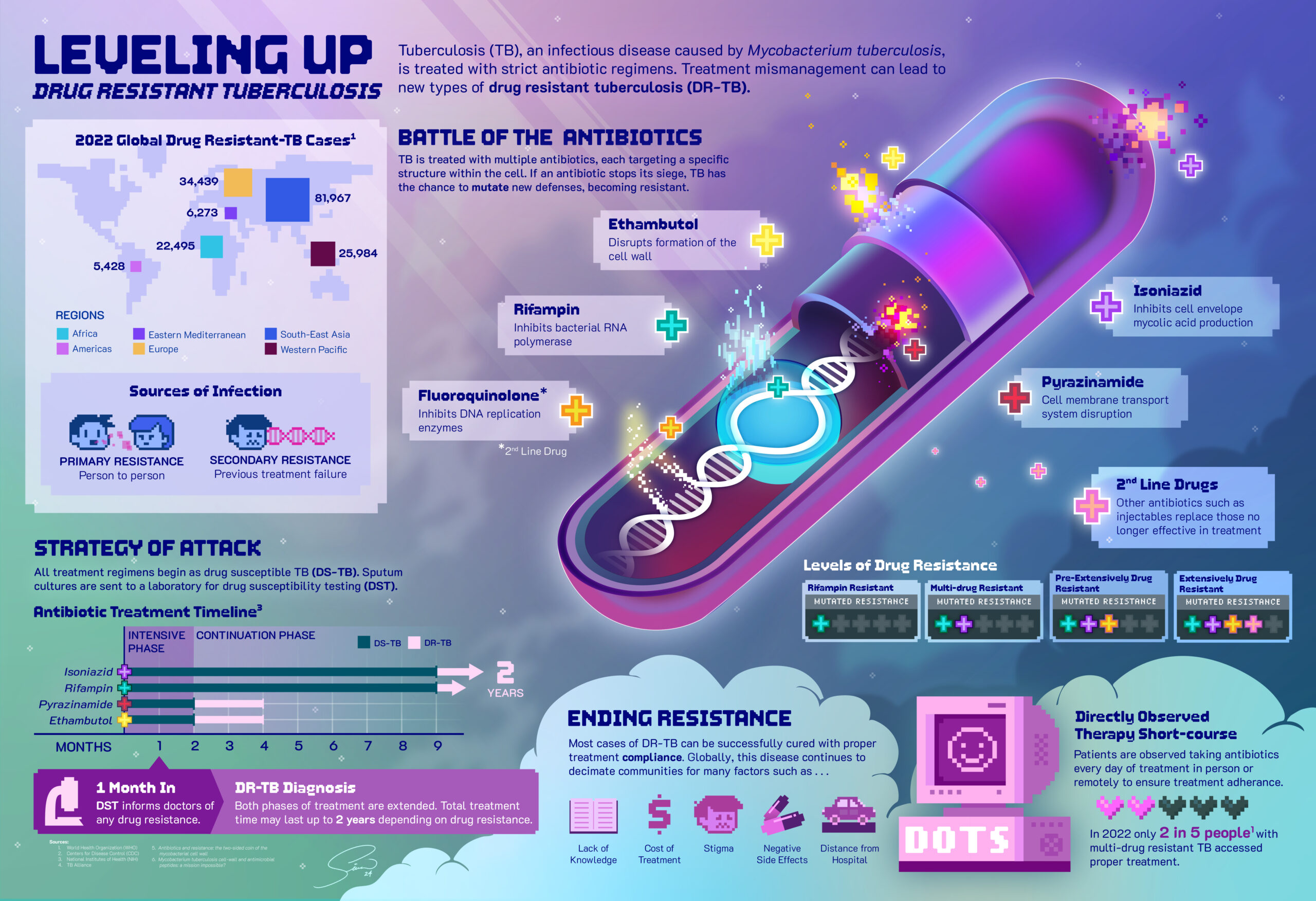
Leveling Up Drug Resistant Tuberculosis
Year
2024
Client
Jeff Day and Jennifer Fairman
Audience
General audience focused with emphasis on immunology and disease prevention scientists
Tuberculosis (TB) is a contagious infectious disease caused by the bacterium Mycobacterium tuberculosis, primarily affecting the lungs but capable of spreading to other organs such as the kidneys, spine, and brain. TB is transmitted through the air when an infected person coughs or sneezes, making it highly communicable. Most people with TB have latent infections, meaning they carry the bacteria but do not show symptoms and cannot spread the disease. However, in active TB cases, symptoms include a persistent cough, fever, night sweats, and weight loss. TB is treatable with antibiotics, but the emergence of drug-resistant forms like multidrug-resistant TB (MDR-TB) and extensively drug-resistant TB (XDR-TB) poses significant treatment challenges, requiring longer and more complex drug regimens. Globally, TB remains one of the leading causes of death from infectious diseases, especially in low-income countries and among immunocompromised individuals.


This infographic was created for my Adobe Illustrator course with professors Jeni Fairman and Jeff Day. We began by selecting topics that had strong, publicly available datasets. I started with resources from the CDC and WHO, which helped me narrow my focus from the broad topic of TB to the critical issue of drug resistance.
I drew primarily from the WHO’s Global Tuberculosis Report 2023. The data included:
Drug resistance types and their respective antibiotics
Continental and country-level statistics
Treatment timelines, diagnostics, and mortality rates
Treatment compliance and DOTS
This gave me a foundation to visualize TB in a way that communicates both the science and the global health challenge. The infographic was designed entirely with vector graphics in Adobe Illustrator. I chose a leveling up / game metaphor to explain the cause of each “level” of drug resistance in TB. Due to the complex defenses of a TB bacterium, several kinds of antibiotics must be combined in an organized attack, each having their own mission. If treatment of any one antibiotic is stopped prematurely, the entire mission is at stake, allowing the bacterium to heal, adapt, and mutate. New mutations require new, stronger antibiotics. This metaphor helped simplify a complex medical subject, teach the importance of completing antibiotic regimens, and make the information approachable to a general audience.